
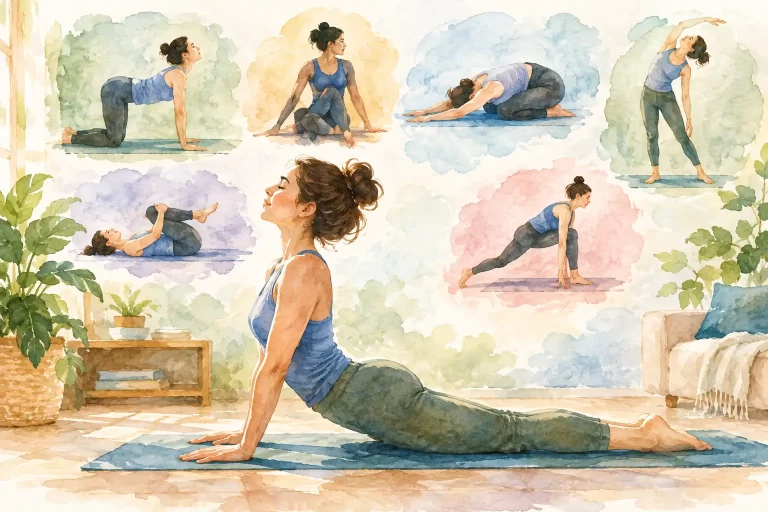
A stable spine is not a rigid spine. It is a spine that can move comfortably, respond to daily demands, and be supported by coordinated muscles from your breath and core through your hips and upper back. The best stretches for spinal stability create space where your body needs mobility while helping you stay aware, controlled, and connected to your alignment.
For many people, long hours at a desk, lifting children, commuting, training, or simply moving through a busy season can leave the body feeling guarded. Gentle stretching can be a meaningful part of your wellness routine, but it works best when it is paired with strength, regular movement, and care that reflects your individual needs.
Why flexibility alone does not create stability
When a tight area finally lets go, it can feel like the problem has been solved. Sometimes that relief is welcome, but lasting spinal stability asks for more than a deeper stretch. Your nervous system needs to feel safe in movement, your joints need appropriate mobility, and the muscles around your trunk, hips, and shoulder blades need the capacity to support you.
That is why aggressive stretching is not always better. Pushing through pinching, sharp discomfort, numbness, or a feeling that you are forcing a position can make your body guard more, not less. Think of these movements as invitations rather than tests. A smaller, calm range with slow breathing is often more useful than trying to reach the furthest possible position.
The following stretches are practical choices for many adults. Move slowly, breathe naturally, and stop if a movement increases pain or produces tingling, weakness, dizziness, or symptoms that travel down an arm or leg. If you are pregnant, recovering from injury or surgery, or managing a diagnosed spinal condition, personalized guidance is especially valuable.
8 best stretches for spinal stability
1. 90-90 breathing with a gentle pelvic tilt
Lie on your back with your calves resting on a chair, sofa, or wall so that your hips and knees are bent near 90 degrees. Rest one hand on your lower ribs and the other on your lower abdomen. Inhale gently through your nose, allowing your ribs to expand in all directions. As you exhale, lightly draw your lower ribs down and allow your pelvis to make a very small tilt, as though you are softening the curve in your low back.
Stay here for five to eight unhurried breaths. This is less about flattening your back and more about noticing how your breath, ribs, pelvis, and deep abdominal support work together. It can be a grounding place to begin when your back feels tired after a long day.
2. Cat-cow with control
Come onto hands and knees with your hands under your shoulders and knees under your hips. As you inhale, let your chest gently broaden and allow your tailbone to tip slightly upward. As you exhale, press the floor away, round through your mid-back, and let your head follow comfortably.
Use a smaller motion than you may expect. The value of cat-cow is not in creating the biggest arch or round, but in helping each part of the spine contribute to a smooth, comfortable movement. Try six to 10 slow repetitions and keep your shoulders away from your ears.
3. Child’s pose with a side reach
From hands and knees, send your hips back toward your heels as comfort allows and rest your chest toward the floor, a pillow, or a stack of cushions. Walk both hands a little to the right to create a gentle lengthening sensation along the left side of your rib cage and low back. Take three to five breaths, then move your hands to the other side.
If your knees, hips, or shoulders do not enjoy this position, widen your knees, elevate your torso, or choose a supported version on a bed. Comfort is part of the exercise. This stretch can be especially helpful when your sides and lats feel restricted from sitting, carrying, or overhead activity.
4. Half-kneeling hip flexor stretch
Place one knee on a cushion and one foot in front of you, with both hips pointing forward. Before leaning forward, gently exhale and bring your pelvis into a neutral position. Imagine lifting the front of your pelvis slightly rather than tucking hard. Then shift forward just enough to feel a stretch at the front of the hip on the kneeling side.
Hold for 20 to 30 seconds per side while breathing steadily. A common mistake is over-arching the low back to chase a bigger sensation. Keeping your ribs comfortably stacked over your pelvis helps the stretch come from the hip rather than asking your lumbar spine to do extra work.
5. Figure-four glute stretch
Lie on your back with both knees bent. Cross one ankle over the opposite thigh, just above the knee, creating a figure-four shape. Stay there if you feel a mild stretch through the outer hip. If you would like more, lift the supporting foot and gently hold behind that thigh.
Let your neck and shoulders relax as you hold for 20 to 30 seconds on each side. The hips and low back share movement during walking, bending, and lifting, so giving the gluteal region some attention can make it easier to move without borrowing motion from the spine.
6. Seated thoracic extension
Sit tall in a sturdy chair with both feet on the floor. Place your hands behind your head without pulling on your neck. Gently lift your breastbone and lean your upper back over the chair back, keeping the movement in the area between your shoulder blades. Return to centre and repeat five to eight times.
This is not a low-back bend. Keep your lower ribs from flaring and make the movement small. When the mid-back becomes stiff from screen time or driving, the neck and lower back often try to compensate. Restoring comfortable upper-back movement can support a more balanced posture.
7. Open-book rotation
Lie on one side with your hips and knees bent, and place a pillow between your knees if that feels better. Extend both arms in front of you at shoulder height. Slowly open the top arm across your body, allowing your chest and upper back to rotate while your knees remain supported. Follow your hand with your eyes only as far as your neck feels comfortable.
Pause for one or two breaths, then return slowly. Complete five to eight repetitions per side. Rotation should feel spacious, not strained. If your low back takes over, place your knees on a larger pillow or reduce the range.
8. Supported hamstring stretch
Lie on your back and loop a towel or strap around one foot. Extend that leg toward the ceiling only as far as you can keep the knee softly bent and your pelvis relaxed. The other knee can stay bent with the foot on the floor. Instead of pulling forcefully, use the strap to support the leg while you breathe for 20 to 30 seconds.
Tightness behind the thigh is not always a hamstring issue. If you feel burning, tingling, or a strong pulling sensation below the knee, ease off and seek individual assessment rather than stretching harder. The goal is a gentle lengthening sensation, not a contest of range.
Make your routine support real life
Choose three or four movements that feel useful for your body and practise them consistently. A 10-minute routine three or four times each week is often more sustainable than an occasional long session. You might begin with 90-90 breathing, move through cat-cow and open books, then finish with the hip flexor and figure-four stretches.
For spinal stability, add simple strengthening on other days or after your stretches. Walking, controlled bodyweight squats, bird dogs, and carries can all build confidence in everyday movement when they are appropriate for you. The right balance depends on your history, current symptoms, work demands, sleep, stress level, and the activities you want to enjoy.
At One Village Family Chiropractic, we see that no two bodies arrive with the same story. An individualized assessment can help identify whether stiffness, movement habits, load tolerance, or another factor is affecting how your spine feels and functions. Gentle chiropractic care and practical movement guidance may be part of a broader plan designed around your goals.
Your body does not need perfection to become more resilient. Give it regular, patient opportunities to move well, breathe deeply, and build trust in what it can do.