
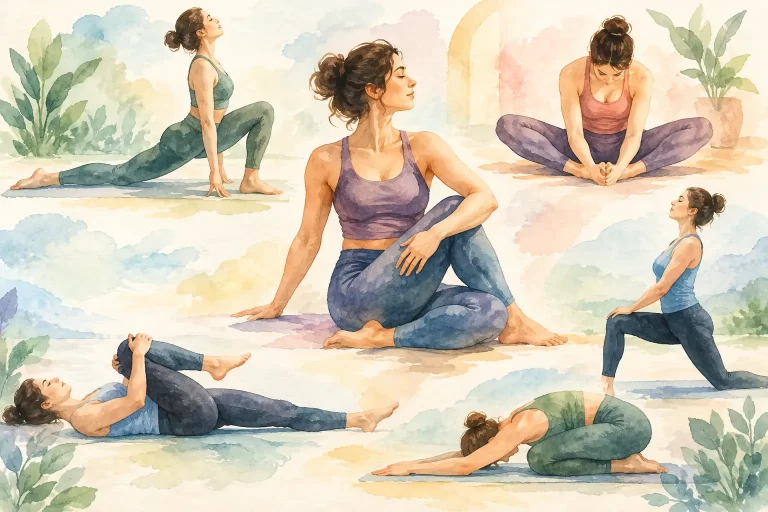
Your hips have a demanding job. They support you through long drives, desk hours, lifting little ones, walking the dog, workouts, and every trip up the stairs. When they begin to feel tight, the discomfort may show up in more than one place: a pinching sensation at the front of the hip, tension through the glutes, stiffness in the low back, or a stride that simply does not feel natural. The best stretches for tight hips are not necessarily the deepest ones. They are the ones you can perform with steady breathing, good alignment, and no sharp pain.
Hip tightness is common, but it is not something you need to push through or ignore. Gentle, consistent movement can help your body feel more at ease, especially when it is paired with supportive posture habits, strength work, rest, and individualized care when needed.
Why hips can feel tight
The hip is a ball-and-socket joint surrounded by powerful muscles, connective tissue, and nerves. Sitting for long periods can leave the front of the hips feeling shortened and the glutes less active. Repetitive training, an abrupt change in activity, stress, poor sleep, and moving around a sore area differently can also contribute to a feeling of tightness.
Still, “tight” does not always mean a muscle simply needs more length. Sometimes the body is guarding a sensitive area, or the hip is being asked to compensate for movement patterns above or below it. That is why forcing a deep stretch can occasionally make things feel worse. A useful stretch should create mild to moderate tension, not numbness, joint pinching, burning, or pain that lingers afterward.
Try these movements after a short walk or a few minutes of easy marching in place. Aim for slow, relaxed breaths, and give your body permission to ease into the position rather than chase a bigger range of motion.
8 best stretches for tight hips
1. Half-kneeling hip flexor stretch
Kneel on one knee with the other foot in front, both knees bent. Place your hands on your hips, gently tuck your tailbone under, and shift your pelvis forward slightly until you feel a stretch at the front of the kneeling-side hip. Keep your ribs stacked over your pelvis rather than arching your low back to go farther.
Hold for 20 to 30 seconds, then switch sides. Repeat two times per side. If kneeling is uncomfortable, place a folded towel or cushion under your knee.
2. Supported figure-four stretch
Lie on your back with both knees bent and feet on the floor. Cross one ankle over the opposite thigh, just above the knee. You may stay here or gently draw the uncrossed leg toward you, holding behind the thigh.
You should feel this through the outer hip and glute of the crossed leg. Keep the movement easy. If your knee feels strained, move the crossed foot farther away from your body or choose the seated version instead.
3. Seated figure-four stretch
Sit tall near the edge of a sturdy chair. Cross one ankle over the opposite thigh and flex the foot of the crossed leg. Keeping your spine long, lean forward from the hips until you feel a comfortable glute stretch.
This is an excellent option for people who spend much of the day at a desk, as well as anyone who finds getting down to the floor inconvenient. Avoid pressing down hard on the raised knee. Let gravity and breathing do the work.
4. 90/90 hip rotation
Sit on the floor with one leg bent in front of you and the other bent behind you, creating two roughly 90-degree angles. Keep both sit bones as grounded as is comfortable. Lean gently over the front shin to explore the outer hip, then return upright.
This position asks the hips to rotate, which is useful for many everyday movements. It can feel intense at first, so sit on a folded blanket or yoga block if your pelvis tips back. If the position creates knee discomfort, skip it and use the figure-four stretch instead.
5. Child’s pose with knees wide
Come onto hands and knees, bring your big toes toward each other, and allow your knees to widen to a comfortable distance. Slowly sit your hips back toward your heels and reach your arms forward. A pillow under your chest can make this position more restful.
You may feel a gentle opening through the inner thighs, hips, and low back. This is less about reaching as far as possible and more about creating a calm, spacious position for a few slow breaths. If you are pregnant or your abdomen needs more room, widen the knees further and use cushions for support as needed.
6. Adductor rock-back
Start on hands and knees. Extend one leg out to the side with the foot flat and toes facing forward. Keeping your spine neutral, slowly shift your hips back toward your heel, then glide forward again.
The motion should be small and controlled, creating a gentle stretch along the inner thigh of the extended leg. Complete eight to 10 slow rock-backs on each side. This dynamic option can feel more comfortable than holding a long inner-thigh stretch.
7. Reclined knee-to-chest stretch
Lie on your back and bring one knee toward your chest, holding behind the thigh or over the shin if that feels comfortable. Keep the other leg bent or extended, depending on what allows your low back to relax. Hold for 20 to 30 seconds before changing sides.
For a slightly different sensation, bring the knee a little toward the opposite shoulder without twisting aggressively. This is a gentle choice on days when your entire lower body feels stiff and you need a lower-intensity starting point.
8. Hip-flexor couch stretch, gently
Place one knee on a padded surface near a wall or couch, with the shin resting up against it if your mobility allows. Step the other foot forward into a lunge. Begin upright, lightly tuck the pelvis, and keep your core engaged.
This can be a strong stretch for the front of the hip and thigh, so less is often more. Start with the back foot lower on the wall or farther from the couch. If you feel cramping, back pain, or pressure in the knee, return to the half-kneeling version.
How often should you stretch tight hips?
For many people, five to 10 minutes of gentle hip mobility most days is more helpful than one long session each week. Choose two or three stretches that feel appropriate for your body, hold them for 20 to 30 seconds, and repeat once or twice. Dynamic movements, such as adductor rock-backs, can be especially useful before walking, strength training, or a busy day on your feet.
Pay attention to what happens afterward. A good session may leave you feeling warmer, freer, and more aware of your posture. It should not leave the area irritated for hours. If it does, reduce the intensity, shorten the holds, or choose a different movement.
Stretching is only one piece of long-term hip comfort. Your hips also benefit from regular walking and gradual strength work for the glutes, legs, and core. If hours of sitting are part of your routine, brief movement breaks can matter more than a single perfect stretch at the end of the day.
When hip tightness needs a closer look
A new or persistent hip concern deserves attention when it is limiting your sleep, walking, work, exercise, or ability to care for your family. Seek prompt medical assessment for significant trauma, inability to bear weight, fever, sudden swelling, numbness, weakness, or unexplained symptoms.
It is also worth speaking with a qualified healthcare professional when tightness keeps returning despite thoughtful movement, or when pain travels into the leg or is accompanied by ongoing low-back discomfort. An individualized assessment can help identify movement habits, joint restrictions, muscle imbalance, or other factors that a generic stretching routine may miss. At One Village Family Chiropractic, care is approached with this whole-body perspective, using gentle, individualized support to help you move with greater confidence.
Your body does not need to earn relief by being pushed to its limit. Start with one comfortable stretch, take a few unhurried breaths, and let consistency become the kindest part of your routine.