
More science, and not less philosophy — that is the chiropractor I want to be
A note for One Village families · From Dr. Wendy Coburn
Every so often, someone asks me — sometimes a patient, sometimes a young chiropractor — whether I am a “science” chiropractor or a “philosophy” chiropractor, as though I had to pick a team. I understand the question. Our profession talks about itself that way more often than it should. But in everyday practice, I have never found the two at war. The longer I practise, the more I am convinced they need each other — and that the people I care for are better served when I refuse to choose.
Two diagrams I have loved for years
Some of my favourite reading is unfashionable: the old Palmer “Green Books,” and especially R.W. Stephenson’s Chiropractic Textbook from 1927. Two of its diagrams have stayed with me since I first opened it.
The first, the Universal Diagram of Cycles, places Innate Intelligence at the top — the organising wisdom that traditional chiropractic philosophy says lives in every living body — and shows it expressed through the brain and the body in an endless set of cycles. Nothing in the picture is static. Everything is moving, adapting, responding.
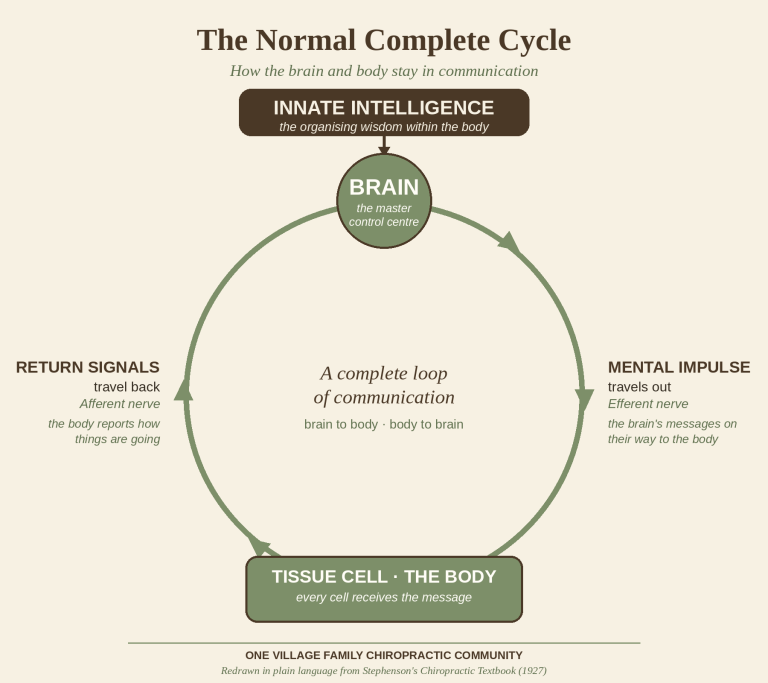
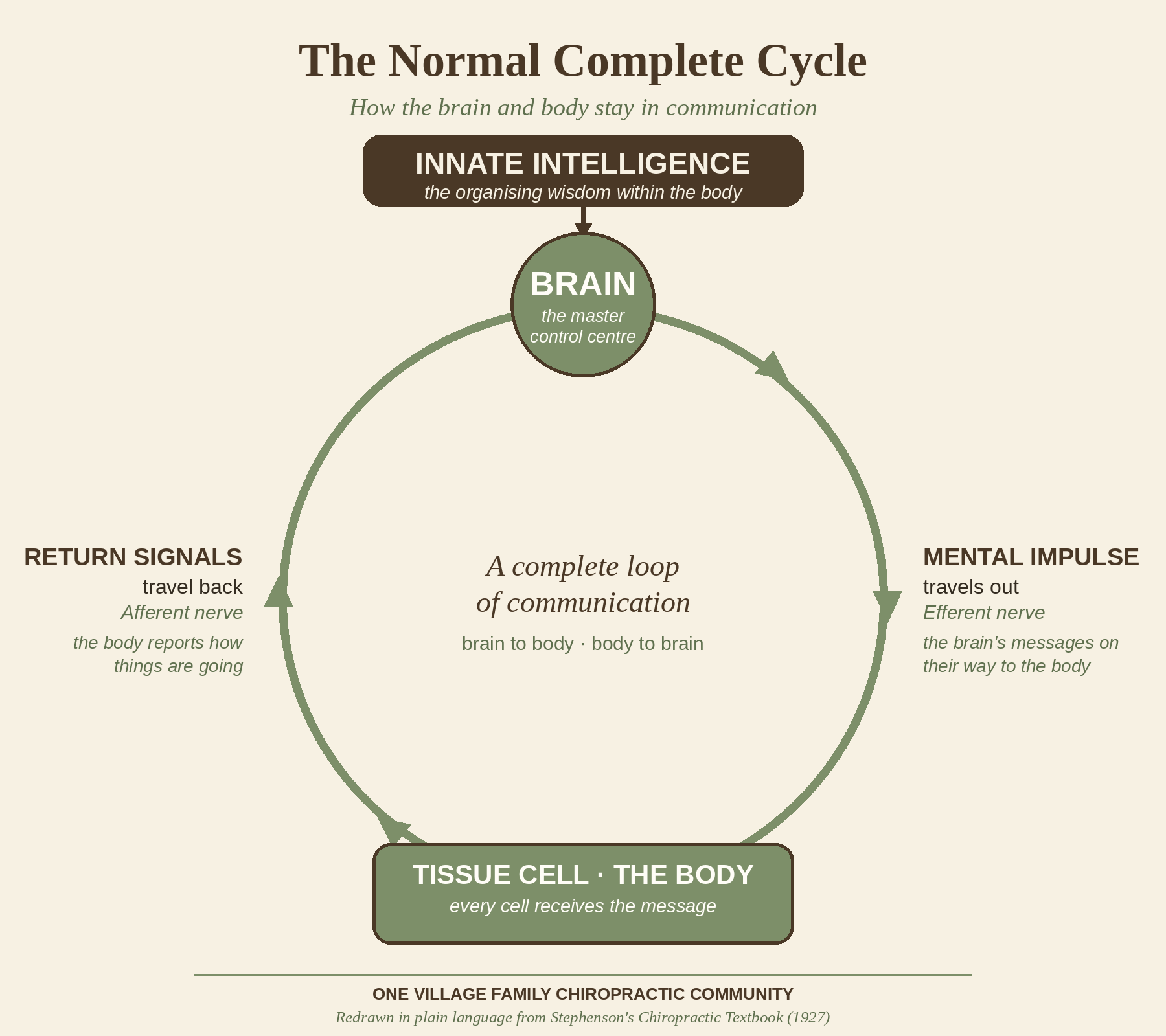
The second, the Normal Complete Cycle, follows a single message on its round trip: formed in the brain as a mental impulse, travelling out along an efferent nerve to a tissue cell at the far reaches of the body, then reported back along an afferent nerve so the brain knows how things went. Brain to body, body to brain — one complete loop of communication.
In the traditional framework, a vertebral subluxation is what happens when that loop is interfered with: the message still travels, but not as cleanly. Whether or not you share the philosophy, the picture itself is a lovely way to understand why chiropractors pay so much attention to the spine — and to the nervous system that runs through it.
What science does in my practice
Philosophy gives me the picture. Science tells me whether what I am seeing in front of me matches it.
That is why assessment at One Village is thorough and measurable. We use CLA Insight scanning — heart rate variability, thermal patterns, and surface EMG — together with PostureRay analysis and a careful neuromusculoskeletal examination, so we are not guessing about how your system is functioning. And we re-check over time, because one snapshot is not the same as a pattern.
Science also keeps me honest about the edges of my work. A solid grounding in neurology, anatomy, and physiology is what allows any chiropractor to recognise when a presentation is not a chiropractic case — and to refer promptly when it isn’t. And good research challenges my assumptions. If a study shows that something I believed does not hold up, I want to know. That is not a threat to the philosophy. It is a service to my patients.
Science tells me what I can measure. Philosophy reminds me why it matters.
What philosophy does in my practice
What the philosophy adds is the lens — the distinct way chiropractic has always looked at health.
It begins with a conviction that the body is not a machine that simply breaks down, but a living, self-healing, self-regulating system, always adapting to its environment. Health, in this view, is not merely the absence of pain; it is the body’s ability to adapt well. That is why a chiropractic assessment looks beyond where it hurts, to how the whole system is communicating — why we check babies who cannot tell us where it hurts, and grandparents whose dearest goal is to keep doing the things they love.
I hold that framework for what it is: the traditional lens of my profession, nearly a century old in Stephenson’s telling, and older still in the Palmers’. It is not a laboratory finding, and I don’t present it as one. It is the “why” behind the work — the reason the measurements in the next room mean something.
More science. Not less philosophy.
So here is where I land, after all these years. I want more science in chiropractic — better studies, better measurement, better questions. And I do not want one bit less philosophy: not the wonder at how the body organises itself, not the cycle diagrams in an old green book, not the conviction that your body is wiser than any of us.
You don’t have to pick a side. Neither do I.
I would love to know what you think. Have you ever felt you had to choose between the measurable and the meaningful in your own health? Tell me next time you’re in — those are my favourite conversations.
— Dr. Wendy
One Village Family Chiropractic Community · Crestwood — (780) 484-2272 · Highlands, Gibbard Block, Edmonton
Diagram redrawn in plain language from R.W. Stephenson’s Chiropractic Textbook (1927). Chiropractic philosophy is presented here as our profession’s traditional framework. Assessments at One Village use current clinical tools, and we refer to other providers whenever that is the right step.