
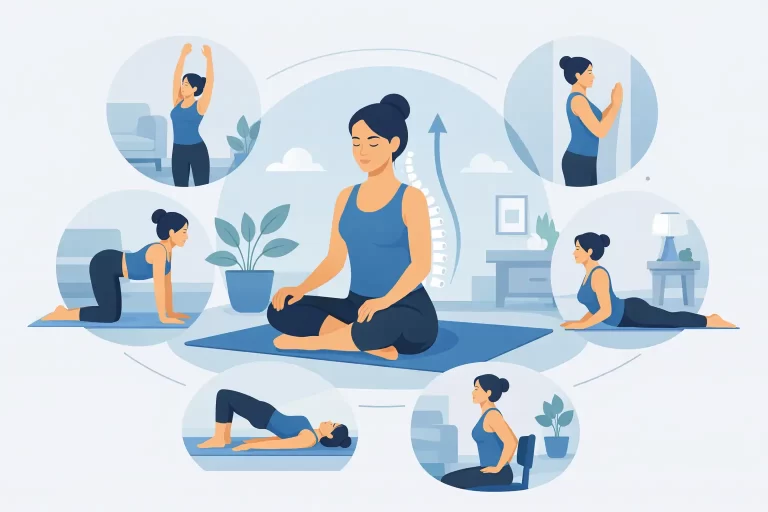
By the time most people notice their posture, their body has already been compensating for a while. Tight hips, a stiff upper back, tired shoulders, jaw tension, and that heavy feeling by the end of the day often show up long before anyone says, “I think I’m slouching.” The good news is that exercises for better posture at home can make a real difference when they are done consistently and with care.
Posture is not about forcing yourself to sit perfectly straight all day. It is about how your body organizes itself around gravity, movement, breathing, and daily habits. A healthy posture supports better joint motion, more efficient muscle use, and less strain on your spine and nervous system. For many people, especially parents, desk workers, pregnant mothers, and anyone carrying stress in their body, posture improves best through gentle retraining rather than aggressive stretching or rigid correction.
Why posture problems start at home
Home is where many posture habits are built. Hours spent nursing a baby, working from a laptop, scrolling on the couch, cooking over the counter, or carrying toddlers on one hip all add up. Even good habits can become stressful when one area of the body has to do too much for too long.
That is why exercises for better posture at home should focus on balance. Some muscles need support and strengthening. Others need to let go. In many cases, the goal is not to “pull the shoulders back” but to help the ribs, pelvis, neck, and shoulder blades work together more naturally.
If any movement causes sharp pain, numbness, dizziness, or symptoms that radiate down the arm or leg, stop and get assessed by a qualified professional. Posture exercise should feel supportive, not forceful.
8 exercises for better posture at home
You do not need a full gym or a long routine to start. A small, repeatable practice usually works better than doing too much once a week. These exercises can be done with just a mat, a wall, and a little floor space.
1. Wall alignment hold
Stand with your back near a wall, feet a few inches away from it. Let the back of your head, upper back, and pelvis lightly meet the wall if that feels comfortable. Keep your ribs soft rather than flared, and breathe slowly for 5 to 8 breaths.
This exercise helps you feel what stacked alignment is like without forcing a military posture. If your head does not easily reach the wall, do not jam it back. The goal is awareness, not strain.
2. Chin tucks
Sit or stand tall and gently glide your head straight back, as if making a double chin. Hold for 3 to 5 seconds, then release. Repeat 8 to 10 times.
This is one of the most helpful exercises for people with a forward head posture from screens or feeding positions. It strengthens the deep neck stabilizers and can reduce the habit of leading with the chin. Go gently. You should feel length, not pinching.
3. Doorway chest stretch
Place your forearms on either side of a doorway and step one foot forward. You should feel a stretch across the front of the chest and shoulders. Hold for 20 to 30 seconds and repeat 2 to 3 times.
A tight chest often pulls the shoulders forward, especially if you spend a lot of time typing or lifting children. Stretching here can create more space for the upper back muscles to do their job. If your shoulders are irritated, lower your arm position and reduce the intensity.
4. Wall angels
Stand with your back against a wall and your elbows bent at about 90 degrees. Slowly slide your arms up and down while keeping them as close to the wall as possible. Repeat 8 times.
This movement improves shoulder mobility and upper back control at the same time. It can be surprisingly challenging, which is often a sign that posture support muscles need attention. If you cannot keep your arms on the wall, work within a smaller range.
5. Cat-cow
Come onto hands and knees. As you inhale, gently lift your chest and tailbone. As you exhale, round through your spine and let your head soften. Move slowly for 8 to 10 rounds.
Cat-cow is not just for flexibility. It helps restore awareness through the whole spine, especially for people who feel stiff in one position all day. This can also be a comfortable option during pregnancy with proper guidance, though range of motion may need to be smaller depending on how your body feels.
6. Glute bridge
Lie on your back with knees bent and feet flat. Press through your feet and lift your hips until your knees, hips, and shoulders form a gentle line. Hold for 3 seconds, then lower slowly. Repeat 10 to 12 times.
Strong glutes support pelvic alignment and reduce the tendency to hang into the low back. For many adults, poor posture is not only an upper body issue. It often starts lower, with weak hips and a pelvis that tips forward too easily.
7. Bird dog
Start on hands and knees. Extend one arm forward and the opposite leg back, keeping your trunk steady. Hold briefly, then switch sides. Perform 6 to 8 repetitions per side.
Bird dog builds core stability without the pressure of traditional ab exercises. That matters because posture needs endurance more than brute strength. If balancing feels difficult, begin with just the arm or just the leg.
8. Child’s pose with side reach
Sit back toward your heels and reach your arms forward into child’s pose. Walk both hands slightly to one side and breathe into the stretch along the opposite side of your body. Hold for 20 seconds, then switch.
This can ease tension through the mid-back and sides of the ribs, areas that often get overlooked in posture routines. Better posture is closely connected to better breathing, and this stretch helps create space for both.
How often should you do posture exercises?
Most people do better with 10 to 15 minutes a day than one long session on the weekend. If your posture has been shaped by years of repetitive habits, change usually comes through frequency, not intensity.
A simple routine might include one mobility movement, one stretch, and two strengthening exercises. For example, cat-cow, doorway chest stretch, chin tucks, and glute bridges make a balanced starting point. If you are short on time, even 5 minutes is worthwhile when it becomes part of your day.
What posture exercises can and cannot do
Exercise helps, but posture is rarely solved by exercise alone. Your workstation setup, sleep support, stress levels, breathing pattern, and daily movement all matter. A parent feeding a baby for hours each day may need different support than someone sitting at a desk or training heavily at the gym.
This is where the trade-off matters. Stretching feels good in the moment, but if weak stabilizers are the real issue, relief may not last. On the other hand, doing only strengthening work when your rib cage or hips are locked up can also feel frustrating. It depends on what your body is compensating for.
That is why posture care works best when it is individualized. Sometimes what looks like poor posture is actually your body protecting an area that feels unstable, tired, or irritated.
When to get extra support
If your posture is connected to recurring headaches, low back pain, shoulder tension, pregnancy discomfort, or persistent stiffness, it may be time for a more complete assessment. Gentle chiropractic care, paired with personalized exercise recommendations, can help identify where your body is adapting and what kind of support it actually needs.
At One Village Family Chiropractic, that whole-body perspective matters. The goal is not to chase a single symptom or tell you to stand up straighter. It is to support better alignment, healthier nervous system function, and more ease in the way you move through daily life.
Small changes that help posture all day
Your exercise routine will go further if your environment supports it. Alternate sitting and standing when possible. Bring screens closer to eye level. Switch sides when carrying children or bags. Take movement breaks before your body forces you to. And pay attention to your breath – shallow chest breathing often reinforces the very tension patterns people are trying to fix.
Posture does not need perfection to improve. It needs repetition, awareness, and a plan that respects your stage of life and your body’s current capacity. A few thoughtful exercises, done regularly at home, can begin to shift the way you feel in your spine, shoulders, and hips. Start gently, stay consistent, and let progress build one day at a time.