
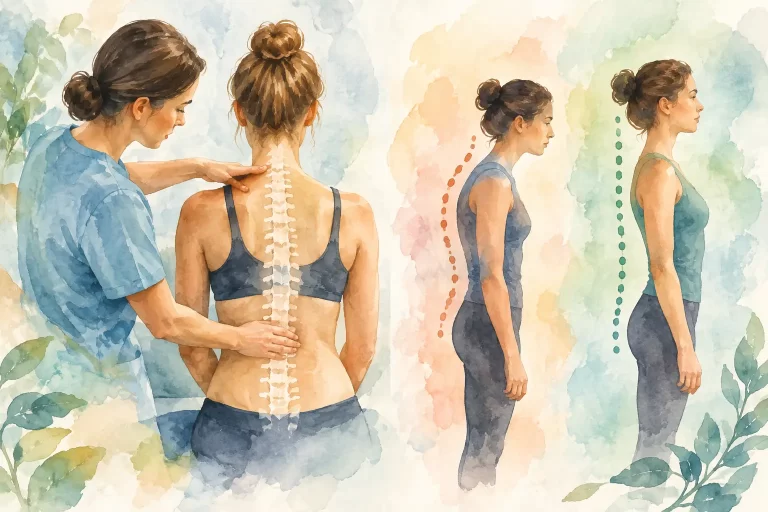
A shoulder sitting higher in a family photo, a child who always leans into one side of the couch, or a desk worker whose neck feels tight by mid-afternoon can all prompt the same question: is this simply posture, or is there more to understand? Spinal assessment versus posture screening is not an either-or choice. Both can be useful, but they answer very different questions about how your body is moving, adapting, and feeling.
For families who value proactive care, knowing the difference can help you choose the right next step without jumping to conclusions based on a quick visual check.
The quick difference between posture screening and spinal assessment
A posture screening is a focused observation of how the body is positioned while standing, sitting, or moving through a simple task. It may identify visible patterns, such as a forward head position, rounded shoulders, an uneven pelvis, or weight that is consistently shifted to one leg.
A spinal assessment is more comprehensive. It uses your health history, conversation about symptoms and daily demands, movement testing, hands-on examination, and other clinically appropriate measures to understand how the spine and surrounding joints are functioning. Depending on the findings, the practitioner may also assess strength, range of motion, reflexes, sensation, or other factors relevant to your concern.
Think of a screening as a useful snapshot. A full assessment is the conversation around that snapshot: what may be contributing to the pattern, whether it is linked to discomfort or reduced movement, and what care or next steps are appropriate for you.
What a posture screening can show
Posture is not a pass-or-fail test. Bodies are meant to move, shift, reach, carry children, sit at a desk, sleep in imperfect positions, and adapt to busy lives. There is no single “perfect” posture that guarantees a pain-free body.
Still, a posture screening can help bring awareness to habits and patterns that may be worth exploring. A practitioner may observe how your head sits over your shoulders, how your ribcage and pelvis relate to one another, whether one shoulder or hip appears higher, and how you distribute your weight through your feet.
When a screening is especially useful
A screening can be a helpful starting point when you are generally feeling well but want guidance about ergonomics, exercise form, backpack use, workstation setup, or everyday movement habits. It can also be valuable for someone returning to activity after time away, or for a parent who has noticed a repeated movement pattern in their child.
Its strength is simplicity. It can start a meaningful conversation and provide practical ideas, such as changing screen height, taking movement breaks, adjusting how you carry a bag, or building more variety into your day.
Its limitation is equally important: posture alone cannot explain every ache, stiffness, headache, or movement concern. Two people can have similar-looking posture and feel completely different. One may have no discomfort at all, while another may need a more detailed clinical evaluation.
What a spinal assessment adds
A spinal assessment looks beyond appearance. It considers how you feel, what you can do comfortably, how long a concern has been present, what makes it better or worse, and how your body moves during the activities that matter to you.
For example, a parent may report low-back discomfort after repeatedly lifting a toddler. An assessment can explore more than the way their shoulders look while standing. It may consider hip mobility, spinal movement, core and leg strength, lifting habits, sleep position, past injuries, work demands, and how symptoms respond to particular motions.
This wider view matters because the visible pattern is not always the source of the problem. A forward head position may be influenced by prolonged screen time, but it can also reflect fatigue, stiffness elsewhere in the body, vision habits, stress, or simply a position someone moves in and out of throughout the day. The goal is not to label every variation as a defect. It is to understand function and identify sensible options.
A careful assessment supports individualized care
A thorough assessment also helps determine whether chiropractic care is appropriate, what a gentle care plan may involve, and when another health professional should be involved. If findings suggest the need for further medical evaluation, imaging, or referral, that should be part of a responsible clinical process.
For people who choose chiropractic care, recommendations should be based on their individual presentation rather than a one-size-fits-all posture correction plan. Care may include gentle chiropractic treatment where appropriate, movement recommendations, home exercises, ergonomic education, and guidance on pacing activities. Progress is best measured by meaningful changes, such as moving more comfortably, returning to an activity, or feeling more confident in daily life, not by chasing a perfectly symmetrical silhouette.
Why posture does not tell the whole story
Posture is dynamic. Your body changes position constantly, and that adaptability is often a sign of healthy movement. The concern is rarely that someone slouches once, sits cross-legged, or carries a baby on one hip. What deserves attention is a persistent pattern paired with pain, stiffness, reduced mobility, weakness, tingling, or difficulty doing ordinary activities.
This is particularly relevant during seasons of change. Pregnancy can bring natural shifts in balance, joint loading, and comfort as the body changes. Children also move through rapid growth and varied play patterns. Adults may notice new tension after a change in work, caregiving, training, or stress. In each case, an individualized assessment gives more useful context than a visual posture score alone.
A screening may reveal that one shoulder appears lower. It cannot, by itself, tell you why that is happening, whether it matters clinically, or which intervention is best. That is where spinal assessment becomes more valuable.
What to expect at a chiropractic assessment
A family-centred assessment should feel collaborative, not rushed. You should have space to explain what you have noticed, what you are concerned about, and what you hope to get back to doing.
Your chiropractor may ask about your health history, current symptoms, previous injuries, work setup, exercise, sleep, and daily routines. They may then observe posture and movement, assess how joints move, and perform relevant physical and neurological testing within the scope of the examination. For children, the approach should be age-appropriate, gentle, and centred on the parent or caregiver’s observations as well as the child’s comfort.
At One Village Family Chiropractic, the purpose is not to create worry around every asymmetry. It is to help individuals and families understand their bodies, make informed choices, and build a plan that fits their goals and capacity.
When to choose a screening and when to book an assessment
A posture screening may be enough when you want general wellness education, a review of daily habits, or a few practical adjustments for work, school, or exercise. It is a low-pressure way to become more aware of how you move.
A full spinal assessment is generally the better choice when discomfort keeps returning, movement feels limited, symptoms are affecting sleep or activities, or you have noticed changes after an injury or major life transition. It is also appropriate when you want professional guidance before beginning a new exercise routine or pursuing corrective tools.
Seek timely medical attention for severe pain after significant trauma, new or worsening weakness, numbness, changes in bowel or bladder control, fever with back pain, unexplained weight loss, or other concerning symptoms. These situations need medical assessment rather than a simple posture check.
Your posture is one piece of your health story, not the whole story. A thoughtful assessment can replace guesswork with clear, compassionate guidance and help you choose movement, care, and daily habits that support the life you want to live.