
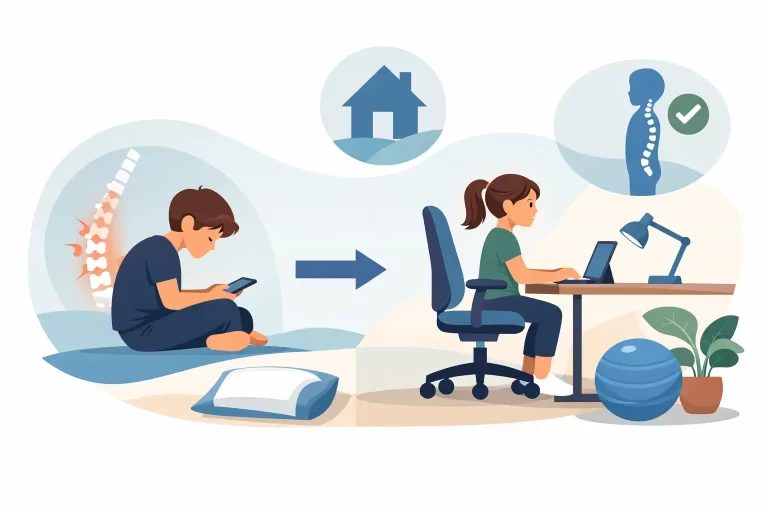
You usually do not notice posture changes all at once. It shows up in little moments – your child leaning far forward over a tablet, slumping at the kitchen table, or complaining that their neck feels tired after homework. Child posture problems at home often build quietly through daily routines, and for many families, the issue is less about one bad habit and more about the way home life is set up.
That matters because posture is not just about standing up straight for a photo. In growing children, posture reflects how their muscles, joints, spine, and nervous system are adapting to the demands placed on them every day. Home should be a place that supports healthy development, but modern routines can easily work against that without anyone realizing it.
Why child posture problems at home are so common
Most children today spend a surprising amount of time in positions that ask very little from their postural muscles. Screens bring the head forward. Soft couches collapse the trunk. Homework at dining tables often means chairs that are too high, tables that are too low, or feet dangling without support. Even leisure time can become very still.
Children are also incredibly adaptable, which is both a strength and a challenge. They can tolerate awkward positions for long stretches without immediately showing pain. That does not mean their bodies are thriving in those patterns. It often means they are compensating.
At home, posture is shaped by repetition. One hour curled up on the couch is not the problem. Six months of daily screen use with little movement variety can be. The goal is not perfection. It is giving a child’s body enough support, movement, and balance that it does not get stuck in one pattern.
What posture changes can look like in children
Some signs are obvious, and some are easy to dismiss as personality, growth, or tiredness. A child may sit in a rounded position all the time, stand with the head pushed forward, or seem to lean more to one side. You may notice uneven shoulders, frequent shifting in a chair, or a habit of propping their head with a hand during desk work.
Sometimes posture concerns show up through function rather than appearance. A child may avoid floor play, tire quickly when sitting upright, complain of tension in the neck or upper back, or seem fidgety during homework because holding the position is hard work. Others may get headaches, have reduced focus, or appear uncomfortable in the car after a long day.
Not every slouch means there is a serious issue. Children are meant to move, wiggle, and change positions. The bigger concern is a posture pattern that is consistent, one-sided, or linked with discomfort, fatigue, or changes in coordination.
The home habits that tend to drive poor posture
Screen use is one of the biggest pieces. Phones and tablets naturally pull the eyes down and the head forward. Because a child’s head is relatively heavy, that position increases demand on the neck, upper back, and shoulders. Over time, it can become their default.
Homework setups are another common factor. Many families make do with whatever table is available, and that is understandable. But when a child’s feet cannot rest on the floor, their knees sit awkwardly, or they have to hunch to see their work, their body has to create stability somewhere else. Usually that means more tension and less efficient posture.
Lack of movement matters too. Healthy posture is not created by forcing a child to sit still and straight. It comes from a body that has the strength, coordination, mobility, and body awareness to move well. If a child spends most of the day sitting at school, then sits again at home, they may not get enough varied movement to support that.
Even emotional stress can play a role. Some children hold tension in their shoulders, jaw, or belly when they are overwhelmed or dysregulated. Posture is not only structural. It is also connected to how safe, calm, and organized the nervous system feels.
What actually helps at home
The first step is to make the environment work better for your child’s body. Their feet should be supported when sitting for schoolwork or crafts. If the chair is too high, a small stool or stable box under the feet can make a meaningful difference. Ideally, the table height allows the shoulders to relax instead of creeping upward.
Screen position matters more than many parents expect. Bringing a screen higher can reduce the amount of head-forward posture, especially for longer tasks. For tablets, using a stand is often better than laying them flat on a table or lap. It does not need to be fancy. Simple changes are often enough.
Movement breaks are one of the most effective tools because they reset the body before strain accumulates. A child does not need a formal exercise plan every time they sit down. Standing up, reaching overhead, crawling, hanging, walking, or doing a few playful movements between activities can help restore variety.
Floor time is valuable too, especially when it includes different positions. Sitting cross-legged, kneeling, lying on the tummy for short periods, and moving through play can build postural endurance more naturally than constant reminders to sit straight. Children usually respond better to movement opportunities than correction.
How to encourage better posture without constant nagging
Most children tune out repeated posture reminders very quickly. If they hear, sit up, shoulders back, stop slouching, all day long, it can create frustration without changing the underlying pattern. Often, they are not slouching because they are careless. They are slouching because that is the easiest available option for their body.
A more helpful approach is to use cues that invite awareness. You might ask, does your body feel comfy there, or can your feet find their support? You can also build simple routines around transitions, like a stretch after screen time or a movement game before homework.
Try to keep the tone supportive rather than corrective. Children do best when they feel helped, not judged. If a setup is not working, change the setup first. If a habit is hard to shift, look at the routine around it rather than assuming your child needs more discipline.
When child posture problems at home need a closer look
It is worth seeking professional guidance if posture changes are becoming more noticeable, if your child has recurring discomfort, or if one side of the body consistently looks or functions differently from the other. Frequent headaches, ongoing neck or back tension, reduced energy for sitting or play, and complaints that keep returning are all worth paying attention to.
The same is true if your child seems clumsy, avoids certain movements, or struggles to stay comfortable in age-appropriate positions. Sometimes the issue is simple and responds well to small changes. Sometimes there is an underlying mobility, alignment, muscle balance, or nervous system component that needs a more individual assessment.
Gentle, family-centred care can help identify what your child’s body is compensating for and what support would be most appropriate. At One Village Family Chiropractic, that often means looking beyond the visible posture itself to understand how spinal alignment, movement habits, stress, and growth patterns may be affecting the whole child.
A healthier posture goal for families
The best posture is not one rigid position held all day. It is the ability to move well, recover well, and use many positions without strain. For children, that means creating a home environment where sitting is supported, screens are used more thoughtfully, movement is part of everyday life, and concerns are addressed early rather than brushed aside.
Parents do not need to create a perfect ergonomic home or monitor every minute. A few thoughtful shifts, repeated consistently, can have a real impact over time. Children are resilient, and when we support their bodies with gentle awareness and the right conditions, healthy patterns often become much easier to build.
If you have been noticing small posture changes in your child, trust that instinct. Early attention is not overreacting. It is one of the kindest ways to support growing bodies before compensation turns into ongoing tension.